ASML
TWINSCAN EXE:5200B
The TWINSCAN EXE:5200B is a dual-stage extreme ultraviolet (EUV) lithography system from ASML. The TWINSCAN EXE:5200B uses high numerical aperture (NA) of 0.55 and a 13.5 nm wavelength to achieve a resolution of 8 nm. The TWINSCAN EXE:5200B is designed to support volume production of sub-2 nm Logic nodes and leading-edge DRAM nodes.[1]
Node / era
sub-2 nm Logic, leading-edge DRAM
Optics
0.55[1]
What it is
The TWINSCAN EXE:5200B is a dual-stage extreme ultraviolet (EUV) lithography system. The system is designed to support volume production of sub-2 nm Logic nodes and leading-edge DRAM nodes. The TWINSCAN EXE:5200B is part of the EXE family, which uses high numerical aperture optics with an NA of 0.55. The EXE family prints features with a resolution of 8 nm.[1]
How it works
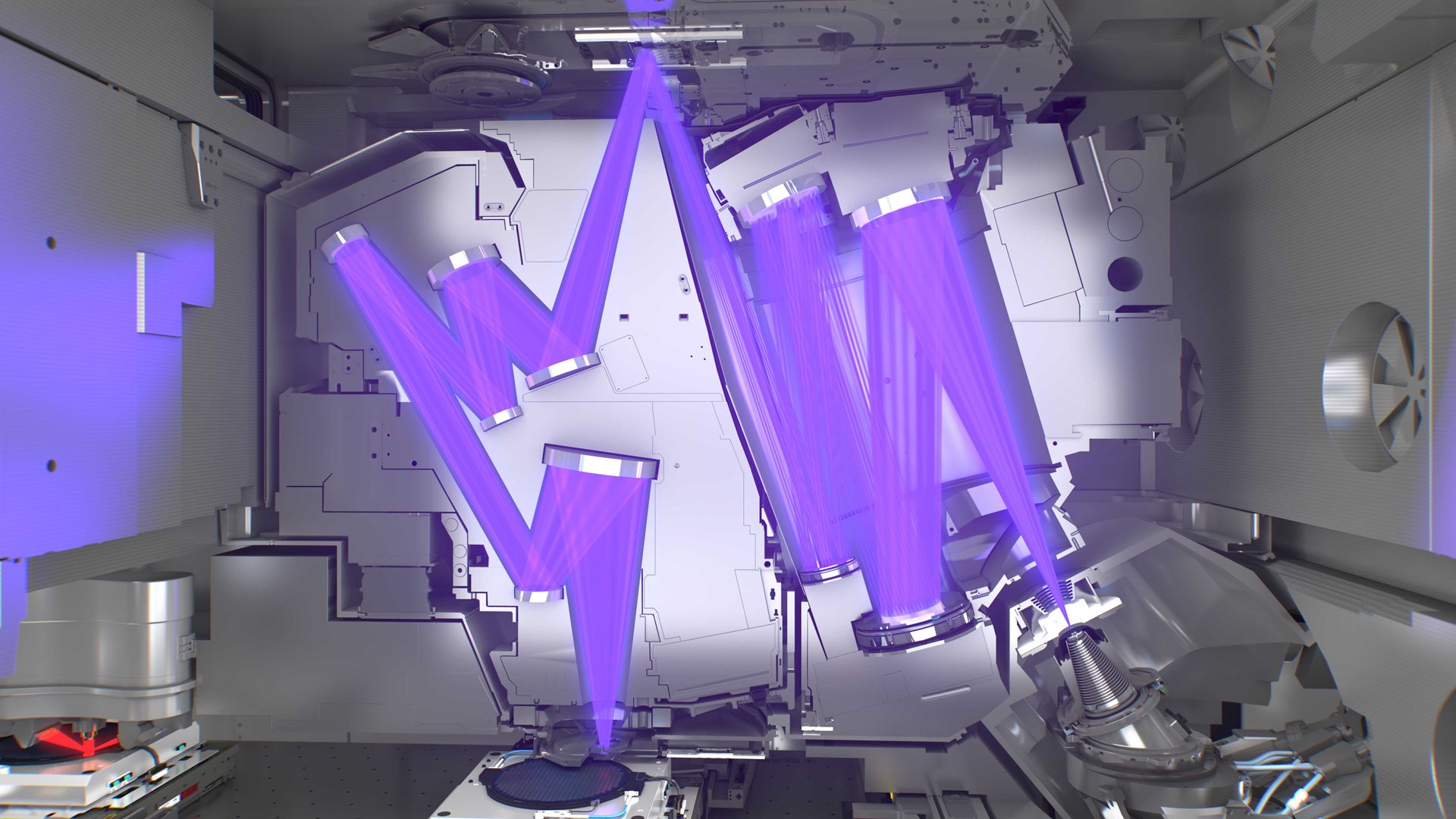
The TWINSCAN EXE:5200B generates EUV light by directing two CO2 laser pulses at a fast-moving drop of tin. The vaporization of the tin creates extreme ultraviolet light with a wavelength of 13.5 nm. The system uses multilayer mirrors instead of lenses to guide the EUV light, shrinking the reticle pattern by a factor of four. The entire optical path must be kept in a high-vacuum environment because air absorbs EUV radiation.[1]
Where it fits in the process flow
In semiconductor manufacturing, EUV lithography systems are used to print the most intricate layers of a chip. The remaining layers are printed using deep ultraviolet (DUV) systems. The TWINSCAN EXE:5200B is intended for the most advanced nodes, specifically sub-2 nm Logic nodes and leading-edge DRAM nodes.[1]
Applications
The TWINSCAN EXE:5200B is designed for high-volume production of sub-2 nm Logic nodes. The system also supports leading-edge DRAM nodes. The EXE platform is intended to enable geometric chip scaling into the next decade.[1]
- Volume production of sub-2 nm Logic nodes
- Volume production of leading-edge DRAM nodes
What do the numbers mean?
Optics & imaging3
Configuration & options2
Vintage & configurations
Documented models & variants
| Designation | Generation | Vintage | Changes | Source |
|---|---|---|---|---|
| TWINSCAN EXE:5000 | High NA | — | First in the EXE generation; supports advanced Logic and Memory chip production. | asml.com[1] |
What replaced it?
Related models
- siblingASML TWINSCAN EXE:5000— Later variant for sub-2 nm Logic and leading-edge DRAM.source[1]
Where are the manuals?
Generated from public-source data on file. Enter your email to access — nothing is published; details are routed privately.
Not publicly documented
Field notes
No research found yet — worked with this tool? Share what you know.
Frequently asked questions
What is the ASML TWINSCAN EXE:5200B?
The TWINSCAN EXE:5200B is a dual-stage extreme ultraviolet (EUV) lithography system.[1]
What logic and memory nodes does the TWINSCAN EXE:5200B support?
The TWINSCAN EXE:5200B supports volume production of sub-2 nm Logic nodes and leading-edge DRAM nodes.[1]
What is the numerical aperture of the EXE platform?
The EXE platform has a numerical aperture of 0.55.[1]
What resolution does the EXE platform print?
The EXE platform prints with a resolution of 8 nm.[1]
How does the system generate EUV light?
The system uses a CO2 laser that fires two pulses at a tin drop, vaporizing it to create EUV light.[1]
Why does the system require a vacuum?
EUV light is absorbed by air, so the entire light path must be kept in high vacuum.[1]
Not publicly documented
The following facts about the TWINSCAN EXE:5200B are absent from this record as of this revision. First-hand knowledge or a citation closes a gap; every submission is reviewed before publication.
No publicly documented production dates or lifecycle milestones (introduction, end of production, EOL) for the TWINSCAN EXE:5200B are on record.
Answerable by: OEM historical records or a trade-press announcement
The control-system platform and OS era of the TWINSCAN EXE:5200B are not on record.
Answerable by: an engineer who operated it or OEM installation records
No publicly documented failure modes or field errata for the TWINSCAN EXE:5200B are on record.
Answerable by: a field service engineer, process engineer, or maintenance technician
No publicly documented compatible parts, consumables, or accessories for the TWINSCAN EXE:5200B are on record.
Answerable by: an OEM parts catalog or a service engineer
No publicly hosted manuals, SOPs, or datasheets for the TWINSCAN EXE:5200B are on record.
Answerable by: university cleanroom staff or an OEM application specialist
No research found yet — worked with this tool? Share what you know.
Sources & citations
Sources (1)Every fact above is drawn from these public sources
- [1]asml.com — asml.comasml.com
Last updated Sep 22, 2026.
Compare with similar tools
View all →Brooks 017-0146-01 is a prealigner manufactured by Brooks.
The EVG 101 is an advanced resist processing system for spin or spray coating and developing of wafers up to 300 mm.
